

On The Way: The Daily Zen Journal
Letter to Masanori Yuno, February 1977
Sodo Yokoyama (1907-1980)

My teacher, the late Sawaki Roshi, often made the following self-evaluation: “I am an eternally deluded person. No one is as deluded as I am. I am deluded with gold trimmings. How clear this is to me when I do zazen!”

What a strange thing this zazen is. When we practice it, distracting ideas, irrelevant thoughts — in short, delusions, which ordinary people are made of, suddenly seem to feel an irresistible temptation to arise and appear at the surface. Then there is a desire to drive these thoughts away, an irresistible desire to which our complete effort is added. Those who don’t do zazen know nothing about this.
Why is it that when we practice, deluded thoughts continue to surface one after the other? The reason, which we learn from zazen, is that each one of us, from prince to beggar, is an ordinary deluded person. The attempt to drive these deluded thoughts away — delusion being so much nonsense interfering with the happiness of oneself and others — is also something brought home to us through zazen. We tentatively call this zazen that guides us in the way, “Buddha.”

According to this teaching, simply the awareness that you are deluded, which comes from practicing zazen, makes you, in reality, a Buddha. It’s zazen that teaches us that we too are deluded, and hence delivers us from this delusion.
When we actually practice zazen and look carefully at all the deluded ideas that keep popping up, we realize how ordinary we are and how little we have to be proud of or to brag about; nothing to do other than quietly hide away. This is, after all, what we truly are.
Satori is being enlightened to the fact that we are deluded. There is then the desire, however small, to stop these deluded acts. That is how ordinary people are saved by zazen. So, we realize, beyond a doubt, our ordinariness through our zazen practice, and any departure from zazen (Buddha) will give rise to the inability to deal with these delusions, and hence, we will lose our way.
We can say that the world has gone astray because it can’t deal with its delusions. Going astray is transmigrating through the six realms. All the troubles in this world, political, economic, and so forth, are created from situations in which the awareness of one’s ordinariness is absent.

Sawaki Roshi said, “Those who are unaware of their ordinariness are, from a religious point of view, shallow and comical.”
Shakyamuni was enlightened beyond all doubt to the fact that he was an ordinary person and became a Buddha. Then he began to live the life of a Buddha. When you realize your ordinariness, you are a Buddha, and when you are a Buddha, no matter how many distracting ideas and irrelevant thoughts appear, they are no match for a Buddha and hence no longer remain obstacles. Delusions that no longer obstruct us are called fantasies. The Buddha way, the way of peace, is the turning of delusion into fantasies.
While the character of Zen is unity, within that unity there are many different characters. Zen is the original face of the universal life. It is the original face of the self.

That’s why my teacher said, “It’s all right not to attain enlightenment; just be sure not to go astray. If you don’t go astray, original face is already there. So remain as you are, be your present self as it is.”
It doesn’t matter how many deluded thoughts you have as long as they don’t obstruct you. In other words, in zazen there are no delusions, no satori, no deluded people, and no Buddhas. And it is for that reason, because from the beginning there is no delusion, no satori, no saint, and no sinner in zazen, that we have shikan taza – just sitting.
The Great Teacher Sekito (700-790) expressed shikan taza in the following way:
“Even if I were, for example, to sink into delusion for eternity, I swear I would not seek the salvation of the saints.” Is there a Buddha or a hell in shikan taza? There is only concentrated single-minded sitting. What a truly majestic expression Sekito used to describe this.
In Buddhism, sitting with this kind of spiritual energy is called “right effort.”
The same teacher, Sekito, expressing himself in a gentler manner, referred to these teachings as follows:
“The white cloud (delusion) is no obstacle to the great sky (zazen).”
And Dogen said, “The wind through the pines echoes in vain upon a deaf person’s ears (a person of zazen).”
Though the wind through the pines blows in vain upon a deaf person’s ears, it does blow. Though delusions are limitless, I vow to put an end to them. Because delusions never cease for us, our zazen practice never ends either. If we are resolved to practice zazen not only through this life but also through countless lives to come, we will then experience a feeling of majestic peace.
Sodo Yokoyama (1907-1980)
Source – Living and Dying in Zazen – Five Zen Masters of Modern Japan – Arthur Braverman 2003
 “If you attach to your human form, you’re in trouble. Whatever you do, you’ll have worries, and …there will be no hope of escape. If you let go of your human form, you won’t need anything. You’ll be like heaven and earth. Heaven and earth need nothing.”
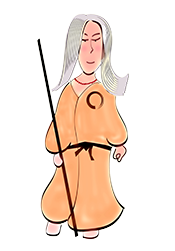
Yokoyama was one of the most unusual Soto Zen monks whose life reminds one of another ordained monk, Ryokan, who is best known by his poetry and love of playing with children. Neither one of them served as head of a temple or trained other monks. Their choice to live without ceremony or pretension demonstrated a purity of practice expressed through everyday life.
For more than two decades, Sodo Yokoyama established his spot in a quiet corner of Kaikō-en Park in Komoro, Japan. He called it his Temple Under the Sky. There were no temple walls, no elaborate altar, only a simple shelter beneath the trees, a bench beside a stream, a charcoal stove for heating water, and a teapot for visitors.
Until his death in 1980, he sat there daily, practicing zazen, serving tea, brushing calligraphy, and playing tunes on a leaf. People came to know him as the Leaf Flute Zen Master.
“All you have to do is decide that wherever you are is the best place there is. Once you start comparing one place to another, there’s no end to it.”

Living simply,
Elana, Scribe for Daily Zen