


If you want to avoid going around in circles, nothing compares to seeking
Buddhahood. If you want to seek Buddhahood, Buddha is mind. Need mind
be sought afar? It is not apart from the body.
The material body is temporal, having birth and death. The real mind is
like space, unending and unchanging. Thus it is said, "When the
physical body decays and dissolves back into fire and air, one thing
remains aware, encompassing the universe."
Unfortunately, people today have been confused for a long time. They do
not know that their own mind is the real Buddha. They do not know that
their own essence is the real Dharma. Wishing to seek Dharma, they
attribute it to remote sages; wishing to seek Buddhahood, they do not
observe their own mind.
If you say that there is Buddha outside the mind, and there is Dharma
outside of essence, and want to seek the Way of Buddhahood while clinging
tightly to these feelings, even if you spend ages burning your body,
branding your arms, breaking your bones and taking out the marrow,
wounding yourself and copying scriptures in your own blood, standing for
long periods of time without sitting down, eating only once a day,
reading the whole canon and cultivating various austere practices, it
will be like steaming sand to produce cooked rice; it will only increase
your own fatigue.
Just know your own mind and you will grasp countless teachings and
infinite subtle meanings without even seeking. That is why the World
Honored One said, "Observing all sentient beings, I see they are fully
endowed with the knowledge and virtues of Buddhas." He also said, "All
living beings, and all sorts of illusory events, are all born in the
completely awake subtle mind of those who realize suchness."
So we know that there is no Buddhahood to attain apart from this mind.
The Realized Ones of the past were just people who understood the mind,
and the saints and sages of the present are people who cultivate the
mind; students of the future should rely on this principle.
People who practice the Way should not seek externally. The essence of
mind has no defilement; it is originally complete and perfect of itself.
Just detach from illusory objects, and it is enlightened to suchness as
is.
Question: If Buddha-nature is presently in our bodies, it is not apart
from ordinary people. Then why do we not perceive Buddha-nature now?
Answer: It is in your body, but you do not perceive it yourself. At all
times you know when you are hungry, you know when you are thirsty, you
know when you are cold, you know when you are hot; sometimes you get
angry, sometimes you are joyful-ultimately, what is it that does all
this?
Now then, the material body is a compound of four elements: earth, water,
fire, and air. Their substance is insentient; how can they perceive or
cognize? That which can perceive and cognize has to be your Buddha-
nature.
This is why Linji said, "The four gross elements cannot expound the
Teaching or listen to the Teaching. Space cannot expound the Teaching or
listen to the Teaching. Only the solitary light clearly before you, that
which has no form, can expound the Teaching or listen to the Teaching."
What he called that which has no form is the stamp of the truth of all
Buddhas, and it is your original mind. So the Buddha-nature is presently
in your body; what need is there to seek outside?
Question: You say that the two categories of sudden enlightenment and
gradual practice are guidelines followed by all sages. If enlightenment
is sudden enlightenment, what is the need for gradual practice? If
practice is gradual practice, why speak of sudden enlightenment? Please
explain the meanings of sudden and gradual further, to eliminate doubts.
Answer: As for sudden enlightenment, as long as ordinary people are
deluded, they think their bodies are material conglomerates and their
minds are random thoughts. They do not know that inherent essence is the
true body of reality. They do not know that their own open awareness is
the real Buddha. Seeking Buddha outside of mind, they run randomly from
one impulse to another.
If a real teacher points out a way of entry for you, and for a single
instant you turn your attention around, you see your own original
essence. This essence originally has no afflictions; uncontaminated
wisdom is inherently complete in it. Then you are no different from the
buddhas; thus it is called sudden enlightenment.
As for gradual practice, having suddenly realized fundamental essence, no
different from Buddha, beginningless mental habits are hard to get rid of
all at once. Therefore one cultivates practice based on enlightenment,
gradually cultivating the attainment to perfection, nurturing the embryo
of sagehood to maturity. Eventually, after a long time, once becomes a
sage; therefore it is called gradual practice. It is like an infant,
which has all the normal faculties at birth, but as yet undeveloped; only
with the passage of years does it become an adult.
Question: By what expedient means can we turn our minds around instantly
to realize our inherent essence?
Answer: It is just your own mind; what further expedient means would you
apply? If you apply expedient means to go on to seek intellectual
understanding, this is like wanting to see your own eyes because you
think you have no eyes if you cannot see them. As long as you have not
lost them, that is called seeing eyes. If you have no more desire to
see, does that mean you imagine you are not seeing? So it is also with
one's own open awareness. Since it is one's own mind, how can one yet
seek to see it? If you seek understanding, then you do not understand
it. Just know that which does not understand; this is seeing essence.
Question: In terms of my present state, what is the mind of open
awareness of silence and emptiness?
Answer: What enables you to ask me this question is your mind of open
awareness of emptiness and silence; why do you still seek outside instead
of looking within? I will now point directly to the original mind in
you, to enable you to awaken; you should clear your mind to listen to
what I say.
Throughout the twenty-four hours of the day, you operate and act in all
sorts of ways, seeing and hearing, laughing and talking, raging and
rejoicing, affirming and denying: now tell me, ultimately who is it that
can operate and act in this way?
If you say it is the physical body operating, then why is it that when
people's lives have just ended and their bodies have not yet decomposed
at all, their eyes cannot see, their ears cannot hear, their noses cannot
smell, their tongues cannot talk, their bodies do not move, their hands
do not grip, their feet do not step? So we know that what can see, hear,
and act must be your basic mind, not your physical body.
Indeed, the gross elements of this physical body are inherently empty,
like images in a mirror, like the moon reflected in water; how can they
be capable of perfectly clear and constant awareness, thoroughly lucid,
sensitive and effective, with countless subtle functions? Thus it is
said, "Spiritual powers and subtle functions - drawing water and hauling
wood."
But there are many ways of access to the principle. I will point out one
entryway, by which you can return to the source. Do you hear the cawing
of the crows and the chattering of the jays?
Student: I hear them.
Now turn around and listen to your hearing essence; are there still so
many sounds in it?
Student: When I get here, all sounds and all discriminations are
ungraspable.
Marvelous, marvelous! This is the Sound Seer's gateway into the
principle. Now let me ask you further: You say then when you get here
all sounds and all discriminations are totally ungraspable. Since they
cannot be grasped, does that not mean that there is empty space at such
as time?
Student: Originally not empty, it is clearly not obscure.
What is the substance that is not empty?
Student: It has not form; there is no way to express it in words.
This is the life of the Buddhas and Zen masters; do not doubt anymore.
Since it has no form, could it have size? Since it has no size, could it
have bounds? Because it has no bounds, it has no inside or outside.
Having no inside or outside, it has no far or near. With no far or near,
there is no there or here. Since there is no there or here, there is no
coming or going. Because there is no going or coming, there is no birth
or death. Having no birth or death, it has no past or present. With no
past or present, there is no delusion or enlightenment....
Those who realize this and keep to it sit in one suchness and are
immutably liberated. Those who stray from this and turn away from it
traverse the six courses and go round and round for eternity. Therefore
it is said that straying from the One Mind to traverse the six courses is
"departure," or "disturbance," while awakening to the realm of reality
and returning to the One Mind is "arrival," or "tranquility."
*
Secrets of Cultivating the Mind was composed by Chinul (1158 - 1210).
Ordained as a monk at eight, Chinul had no teacher. His first awakening
occurred as he read a Chan Buddhist classic when he was 25 years old.
After that Chinul went into seclusion in the mountains. Eventually
Chinul began to instruct others and this manual of meditation clearly
defines and contrasts the principles and methods of sudden and gradual
enlightenment.
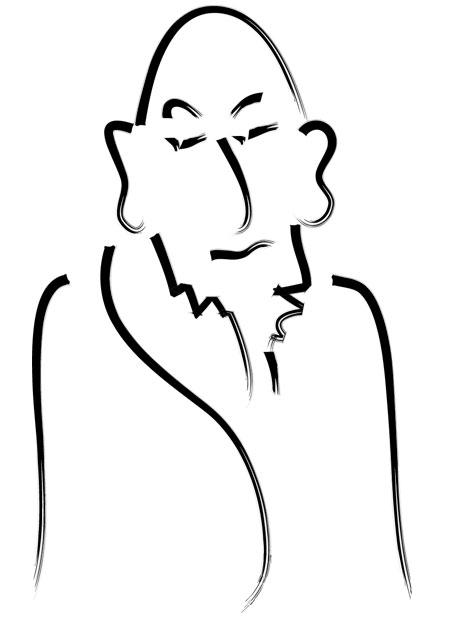
Son Master Chinul
- taken from Minding Mind - A Course in Basic Meditation, edited and translated by Thomas Cleary (1995)


I would agree with Chinul in his assessment that people are very
confused in his time as well as today about practice, and make the Way a
perplexing search at times. Chinul manages in this translation to give a
direct glimpse into original mind. If you can enter into the reading,
you can feel the questions of the student and perhaps experience first
hand the seeing into that which is, uncomplicated and always so.
*
We ask the same kinds of questions today as in Chinul's time:
Question: What is beholding the luminosity of the Mind?
Answer: If your mind is very quiet, you will see the very energy which
is moving, which allows you to be an animate being. It is your
awareness. It is to actually fold back into your awareness. It is to be
your awareness. It is to be that luminosity. Beholding the luminosity of your own mind is meditation. As you go deeper you see more; you spend more time with it and you see more.
Continuing along the Way,
The Monkess